
Identify Who Owns Toombs County Property
The Toombs Tax Assessors qPublic page is the starting point. It supplies the parcel identity and the owner display. For the recorded conveyance itself, turn to the latest deed indexed by the Clerk of Superior Court or GSCCCA.
- Search the situs address, then try the owner name or exact parcel ID.
- Save the owner display, legal description, map number, and book/page clues.
- Search Toombs County in GSCCCA by party name or known book and page.
- Compare conveyance, recording, and portal dates before stating who owns it.
Sources Behind a Toombs County Property Owner
Each county office answers a different part of the question. The assessor fixes parcel identity, the Tax Commissioner adds bill context, and the Clerk holds the recorded instruments that carry title.
| Source | Owner Info It Gives | Access |
|---|---|---|
| Tax Assessors | Owner display, parcel, description, value | qPublic or 912-526-6291 |
| Clerk and GSCCCA | Grantee, grantor, instrument, book/page | Index or courthouse |
| Tax Commissioner | Taxpayer, tax year, bill, parcel | AssuranceGov or 912-526-8575 |
| Probate Court | Executor, administrator, heir, sale authority | Courthouse Suite 23 |
The owner of record is not always the occupant. A mailing address is only a contact clue, not proof that anyone lives on the parcel.
Match the Legal Description, Not Just a Name
A matching name alone proves nothing. Compare the parcel code, acreage, subdivision, lot and block, GMD, situs, and book/page. Check all of these before trusting a hit. Toombs notices preserve codes such as V08 201/202 and C08B056. Search the exact form first. The county publishes no official key to those letter prefixes. The first character therefore does not reveal a city. Rural deeds often lean on roads, creeks, survey calls, and adjoining owners. They may list these instead of a street number. Such details can separate two people who share a name. They also tie an older deed back to the present parcel.
Compare Toombs County's Three Ownership Clocks
Think of three clocks running at once. The assessor record is a digest snapshot. The tax result is a billing snapshot. The deed index is a recording snapshot. A new grantee can land in the deed book well before qPublic catches up. Keep the deed's effective date, its recording date, and the portal's as-of date side by side. When the clocks disagree, report the gap instead of trusting whichever webpage looks freshest. Ask the assessor when its digest updates. Ask the Clerk for the newest instrument tied to the same legal description.
The official Toombs Tax Assessors landing page shows the county route for starting an ownership check.
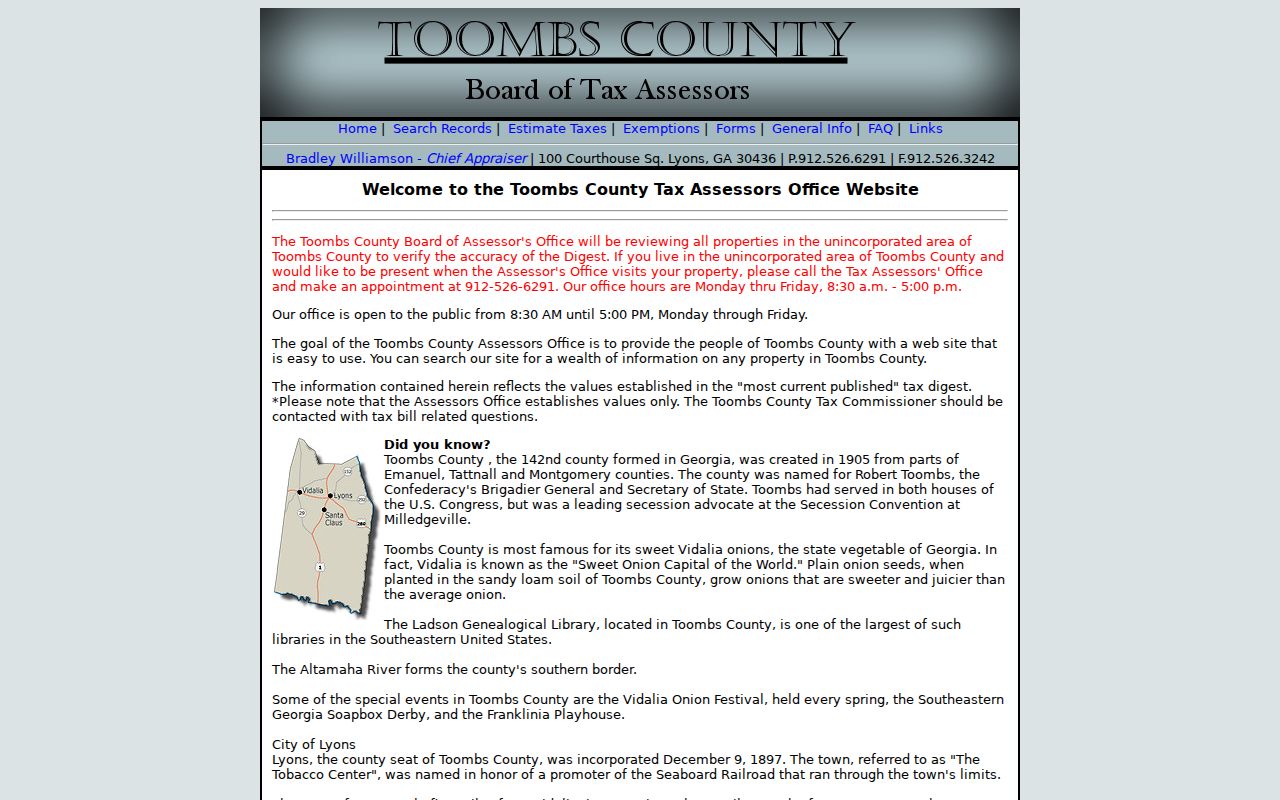
Use its parcel route as the first source. Then trace the matching legal description forward to the latest recorded deed.
Entity and Estate Owners Require Another Link
A parcel listing an LLC or trust needs one more link. Search that exact legal name as both grantee and grantor. Georgia's corporations search can confirm filing names and agent details. But a corporate filing does not prove land title. When an executor, administrator, guardian, or surviving spouse signs a deed, Toombs Probate Court may document that person's authority. Try initials, prior surnames, punctuation variants, and capacity words too. Compare every hit against the parcel description before treating it as the true owner.
Tax Deeds Complicate Who Owns This Property
A tax sale is not an ordinary market transfer. Truman Park notices for parcels V08 201 and V08 202 included a tax deed and a redemption notice expiring February 4, 2025. During that window, the assessor, the tax bill, and the recorded deed can each point to a different role. So can the redemption rights.
Read the tax deed and the redemption notice. Also read later deed entries, liens, and any court or probate file before calling ownership settled.
Toombs City Records Add Use and Occupancy Context
Vidalia, Lyons, and Santa Claus keep permits, zoning, ordinances, and related municipal records. Those files can name an applicant or reveal later work. But they never replace county title records. Confirm the city limits first. A postal city does not settle jurisdiction. Where no permit database exists, request records by address. Include the parcel ID, permit type, and date range. Ask for applications, inspections, zoning cases, and certificates of occupancy.
When the Online Toombs Owner Result Is Incomplete
Some doors simply need a different knock. The direct qPublic application sits behind a browser challenge. The Clerk's local case-search interface requires a login. Neither limit means the record is private or missing. Call the Tax Assessors Office for a parcel-card printout. Use the courthouse terminal. You can also ask the Clerk to locate an instrument by party, date range, legal description, and book/page. A written Georgia Open Records request can reach any county or city file. It works even for files that are not published online. Name the custodian, the parcel, the address, the record type, and the dates. Georgia guidance says an agency should produce records within three business days when practicable. Otherwise it can provide an estimate and a reason for delay. The law does not require staff to write an ownership opinion. Request the actual card, deed, permit, or index entry instead.
Liens and Plats Do Not Automatically Name the Fee Owner
GSCCCC's real-estate, plat, lien, and UCC search routes answer different questions. A lien names a debtor or claimant. A plat names a survey caption or a party. Neither substitutes for the vesting deed. A security deed marks a secured interest rather than who owns the land. Use these records as cross-checks. Match their county, party, parcel description, recording date, and book/page against the deed chain. The distinction matters most when a property shows a recent loan, tax fifa, environmental covenant, or subdivision plat. That matters when there is no ordinary sale in the same period.
Phrase a Toombs Ownership Finding with Dates
State what the assessor actually shows first. Name the owner of record exactly as the tax roll lists it. Add the digest or portal date if the county publishes one. Then find the latest deed in the deed records. Note its grantee. Flag any mismatch instead of smoothing it over. A newer deed, a tax sale, a probate transfer, or a delayed digest update can change the answer.
For purchase or boundary decisions, a property records check is not a title examination. Pull the recorded deed images. Bring in qualified help when legal ownership, exceptions, or insurability must be settled.
Limits on Asking Who Owns This Property
Public property records can name an owner of record and reveal recorded interests. They cannot prove occupancy or guarantee a complete title chain. Georgia law allows protected personal details to be redacted, so use owner information for lawful purposes like purchase, boundary questions, estate work, tax matters, fraud prevention, and civic research.
Lawful use. Verify an ownership result with its Toombs County custodian, and never use owner data to stalk, harass, threaten, or harm a person.
A saved owner result can go stale fast. Before relying on one, repeat the Clerk property search, since new instruments may post to the deed records after your earlier check.