
Compare Toombs County Property Value Types
Georgia property assessment starts with fair market value as of January 1. Toombs County's public tax guidance states that assessed value is 40 percent of fair market value under O.C.G.A. §48-5-7. That ratio explains why an assessed figure should normally be lower than the county's fair market figure, while exemptions can make the taxable amount different again.
| Value | What It Is | Where |
|---|---|---|
| Fair market value | The county's January 1 estimate of full value for assessment | Tax Assessors record and assessment notice |
| Assessed value | Forty percent of fair market value under Georgia's stated level | Tax Assessors parcel record |
| Taxable value | The assessment amount after applicable exemption treatment | Assessment and tax records |
| Last sale price | Consideration tied to a prior transfer, subject to deed context | Recorded deed, transfer material, or assessor sale history |
None of these numbers predicts today's sale price. The county figure is a mass appraisal pinned to a fixed date, while a sale price reflects one particular bargain that may bundle multiple parcels, personal property, or family terms. Save the parcel IDs and the recording reference first. Only then does a deed amount work as comparable evidence.
Who Sets a Toombs County Assessed Value
Two county offices split the property tax workload in Toombs County. The Tax Assessors Office establishes values and maintains the assessment data. The Tax Commissioner bills, collects, and disburses ad valorem taxes. It sets neither the value nor the millage. Keeping those roles straight matters. A billing screen is not a valuation method. Citing it as one misreads how the county works. For the assessment route itself, use the official Toombs County assessor landing page.
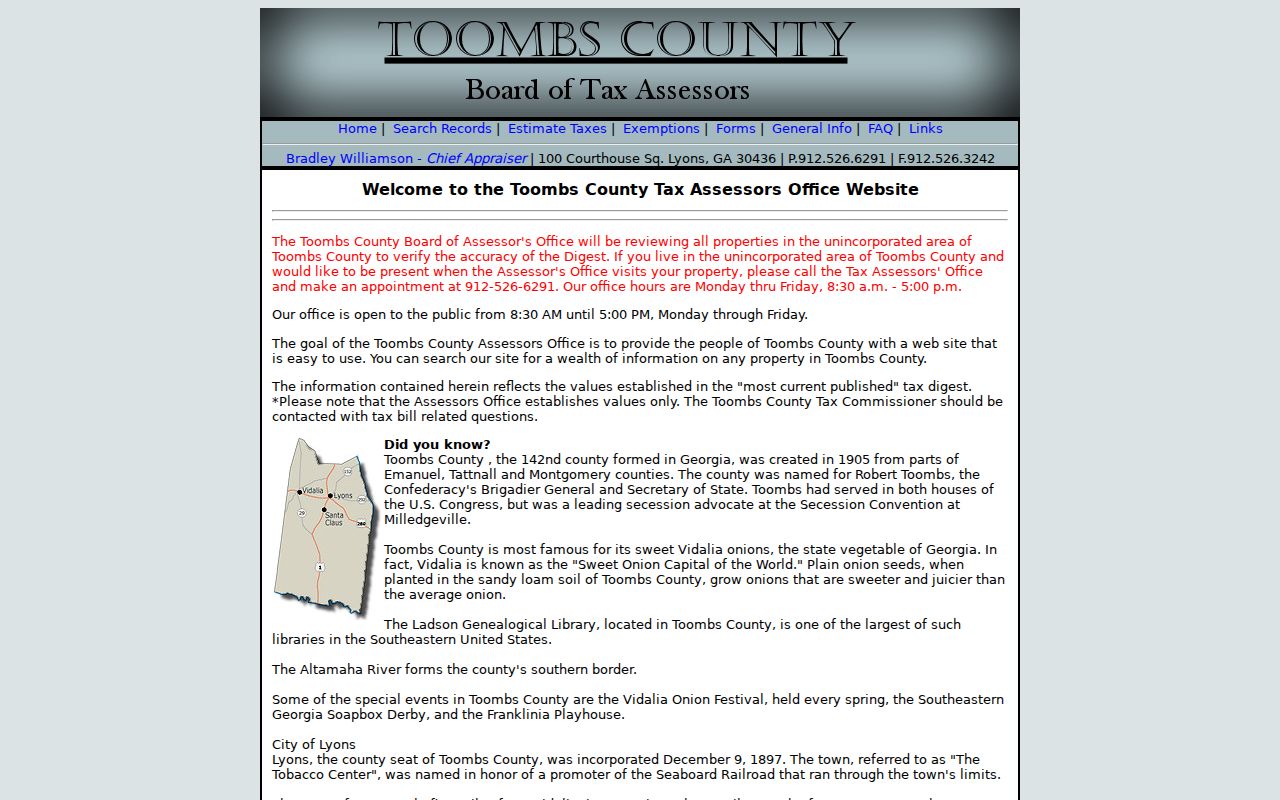
That landing page is the entry point for county assessment records. It is not a parcel appraisal. It never replaces opening the current property card for the parcel you care about. Staff review property in unincorporated Toombs County to keep the digest accurate, and the page links directly into the qPublic application where parcel records live. The office sits at 100 Courthouse Square, reachable at 912-526-6291 during posted weekday hours. Municipal addresses still flow through the county assessment system. A city may run its own permits, zoning, or payment material, yet the underlying appraisal data comes from the same county source.
January 1 Anchors Toombs County Property Value
A property value without a date is incomplete. The county's general tax information says fair market value is set as of January 1, while assessment-change notices, digest publication, a deed's sale date, and the later tax bill each follow their own clock. Improvements or transfers after the valuation date may not be reflected in the same year's displayed figure.
Toombs County publishes digest and levy PDFs covering 2020 through 2025. Those countywide documents supply helpful context. They do not replace the parcel card. Pull the individual assessment record for the parcel's value, and treat the digest as background on the wider tax-year setting.
A Toombs County Sale Can Cover More Than One Parcel
One sale can cover more than one parcel. A Vidalia commercial property at 1612 US Highway 280 is also listed as 1612 E First Street. That case shows why. A Georgia DCA appraisal ties it to tax IDs C27C004, C27C005, and C27C006. It reports a 2016 sale for $594,196. The deed sits in Book 1154, page 118. An environmental covenant separately describes C27C006 as about 2.8 acres. It points to further deed material. None of that yields a current value for any single component parcel. Before dividing or comparing a price, read the deed image, the legal description, the parcel configuration, and the sale date. Also read the transaction conditions. Watch for splits, combinations, and renumbering. A modern parcel may have changed after the sale. If so, reconstruct the configuration that existed on the transfer date.
Locate a Toombs County Property Value
The official qPublic landing page is the starting point for a Toombs County assessment search. The direct application itself sits behind a challenge screen. Use the strongest identifier available. Read the year printed next to every figure, and call the assessor when the live controls or parcel card cannot be reached.
- Open the Toombs County Tax Assessors page and follow its parcel-search link.
- Search the exact address, owner, or full map/parcel ID, then confirm the legal description and acreage.
- Record the fair market, assessed, and taxable figures only if shown, along with their tax year.
- Use the latest recorded deed and its book/page to examine sale consideration and parcel scope.
- Compare like dates, property types, and parcel configurations before drawing a value conclusion.
- Assessed value
- The statutory percentage of the county's fair market value used in assessment.
- Fair market value
- The assessor's full-value estimate as of the applicable valuation date.
- Assessment ratio
- The relationship between assessed and fair market value, stated locally as 40 percent.
- Sale consideration
- The amount or value associated with a recorded transfer, read with the deed's terms.
- Reassessment
- A later valuation action that can change the figure on the assessment roll.
Exemptions Change Taxable, Not Market, Meaning
An exemption shrinks what gets taxed. It does not prove the parcel itself lost market value. That is the difference between assessed value and taxable value. The two numbers should stay separate. The Toombs County assessor approves exemptions. The Tax Commissioner then applies the resulting figures when the tax bill goes out.
Questions about eligibility, a bill, or an appeal belong with the property-tax material. They do not belong on a value card. For a valuation comparison, just label the number: fair market, assessed, or taxable. Say whether an exemption touches it too.
Recorded Price and Toombs County Assessed Value
The Clerk of Superior Court records Toombs County deeds. GSCCCA opens the deed records index by name or book and page. An index entry may list parties, location, instrument details, and book/page. Only the deed image shows the legal description, consideration, exhibits, and stamp. A security deed amount is secured debt, not a sale price.
Some transfers need extra care. Family conveyances, quitclaims, executor deeds, corrective deeds, tax deeds, and multi-parcel sales rarely reflect the open market. A tax deed also carries process and redemption context, so it is a poor comparable. If the deed records image is unavailable, request the instrument or a certified copy from the Clerk. Do not guess from a notice.
Keep Toombs County Value Meaning Separate From Appeals
Interpreting a value on a Toombs County record is one thing. Contesting that value is another. The assessor mails assessment-change notices and takes in appeals. It also accepts property tax returns during the state's local filing window. County guidance spells that window out. None of that machinery changes what the recorded figure means or where it came from. This page draws the line there. Deadlines, exemptions, bills, and millage belong with the Toombs County property tax records.
Anyone studying a parcel can still keep good notes. Save the notice date. Save the prior and current figures. Note any appeal filing and how it ended. When an appeal revises the record, note which version you relied on.
What Toombs County Property Value Cannot Prove
A Toombs County assessment value is a mass-appraisal figure built for public administration. It certifies nothing about a building's physical condition. It will not resolve a boundary, disclose every easement, or guarantee a sale price. But it never replaces a title examination. The valuation date may even lag behind the latest deed or a recent improvement.
Value is not price. A Toombs County assessed value supports taxation and is not a promise of what the property would sell for. It is not a private appraisal.
Buyers should pair the dated assessment with other records. Pull the deed, the plat, permits, and environmental files, and add a qualified appraisal when the stakes call for one. Say plainly when a figure came from a public assessment rather than a market analysis.