
Build a Toombs County Former-Owner Timeline
Start by pulling the current parcel card just to fix the land in mind. Then treat the newest recorded deed as your first link. The statewide GSCCCA index supplies parties, instrument details, property location, and book/page where available. Missing images or local volumes can come up. For those, the Clerk of Superior Court at 100 Courthouse Square is the fallback.
| Source | Years It Covers | Where Held | What It Shows |
|---|---|---|---|
| GSCCCA real-estate index | Statewide system, exact Toombs cutoff unconfirmed | Online index and Clerk | Parties, instruments, book/page |
| County deed books | Ask Clerk for exact volume coverage | Clerk vault or courthouse terminal | Earlier conveyances |
| Historic plats | Online framework from at least 2004; older images vary | GSCCCA plat index and Clerk | Subdivision, lot, and survey history |
| Archives and newspapers | Toombs newspapers from 1904/1905; archive holdings vary | Georgia Archives, Virtual Vault, GALILEO | Locators for prior parties and notices |
Log one row per transfer. Never guess a missing link. A security deed, lien, plat, or tax notice can point toward useful evidence, but none of them is automatically a conveyance of fee ownership.
Book and Page Are Toombs County Breadcrumbs
Local examples show how references survive address changes. The Peterson-Wilbanks record trail points to Deed Book 244, page 155. Lyons subdivision records cite Plat Book 3, page 108 and Deed Book 613, page 65. Whenever one deed hands you a citation, copy it exactly into the next search.
Use the GSCCCA book/page search whenever a notice supplies those keys. A volume or image may be absent. If so, ask the Clerk to check the physical or locally indexed book. A gap is not the end of the chain.
The linked book-and-page form is the official statewide search screen. It offers county, book, and page inputs.
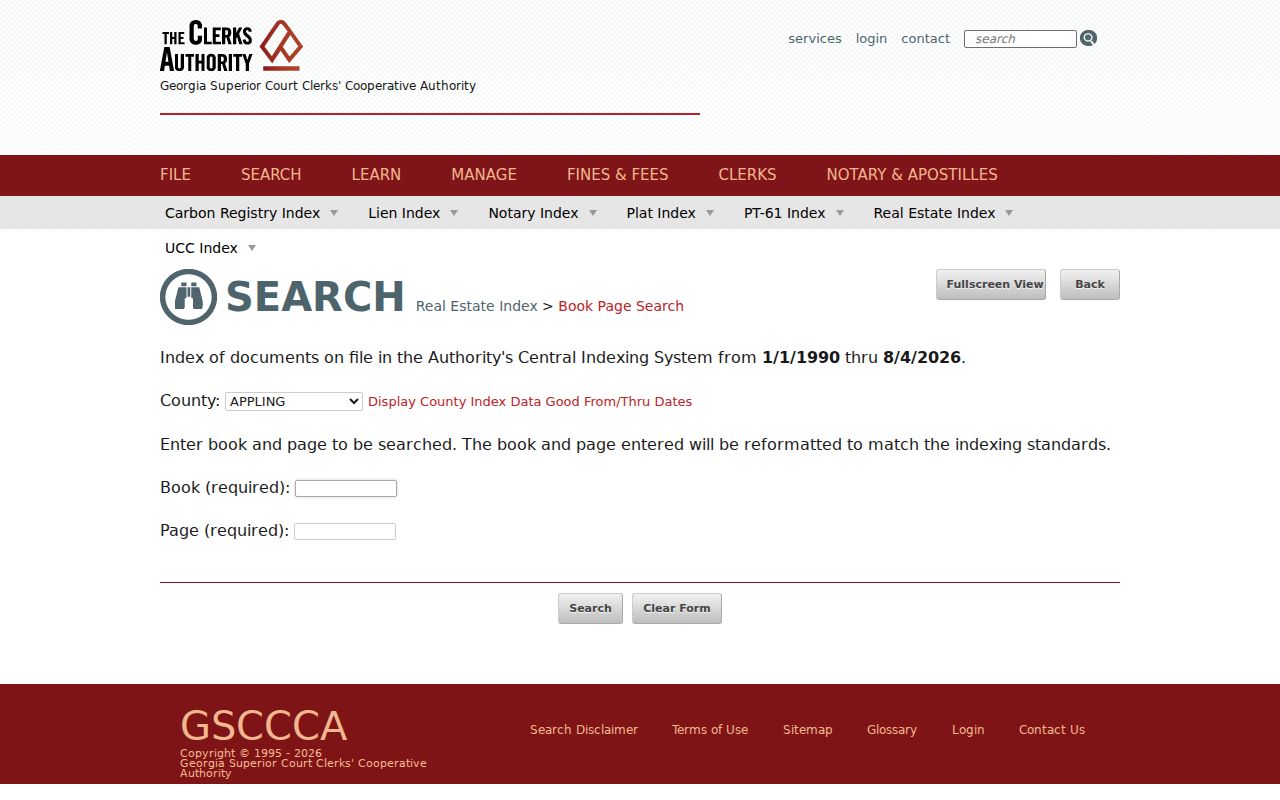
Those inputs turn a citation from an older deed or legal notice into the next document request.
Historic Newspapers Bridge Former-Owner Gaps
Georgia Historic Newspapers carries The Vidalia Advance from 1904, The Lyons Progress from 1905, The Advance for recent years, and a 1911 Toombs County Local issue. Search former owners with subdivision names, tax sale, probate, petition, notice, and deed or plat references.
Treat OCR as a locator only. Record the issue and page. Then verify every party, parcel, and book/page with the Clerk, tax office, or certified instrument. One misread character can point to another tract entirely.
Reconstruct the Toombs County Deed Chain Backward
Open the newest deed for the subject legal description. Its grantee received the land. Its grantor is the next former owner to research. Search that grantor as a prior grantee, restrict the dates, and compare each candidate's description against your tract.
- Find the current owner's acquisition deed and verify the grantee and land description.
- Read the grantor as the next former-owner candidate, then locate that party's acquisition deed.
- Search that former grantor as a grantee in an earlier date range and match the land description.
- When online results stop, continue through Clerk deed books, archives, probate files, and newspapers.
- Grantor and grantee
- The conveying party and receiving party named in a deed.
- Chain of title
- The ordered sequence of conveyances tied to the same land.
- Reverse index
- An index used to follow a party backward into an earlier acquisition.
- Warranty and quitclaim deeds
- Different instrument forms whose legal effect must be read from the record.
Estates Can Change the Name in the Chain
A prior owner may leave the record through an executor's, administrator's, guardian's, or surviving spouse's deed. Toombs Probate Court handles wills, estate administration, determination of heirs, and year's-support matters. It also hears petitions to sell or encumber property.
When a fiduciary signs, record the estate name and capacity. The probate file can explain the authority. The recorded deed documents the actual conveyance. Without both layers, a family-history clue is not a title conclusion.
Address Changes Need Not Break Ownership History
Streets change names. The Vidalia commercial site tied to C27C004, C27C005, and C27C006 appears as both 1612 US Highway 280 and 1612 E First Street. A former-owner search built on one street phrase alone could miss an earlier deed. It might also miss a covenant.
Follow the legal description instead. Parcel IDs, acreage, survey references, and adjoining land settle the question. Search both address forms, but let the land description decide. The land description tells which records belong in the same chain.
Peterson-Wilbanks Connects Deeds to a 1924 Map
The Peterson-Wilbanks House boundary documentation links a 1924 Sanborn map with Toombs Deed Book 244, page 155 and a later deed. That pairing is a useful model for house-history research. A historic map can show the built setting. The deeds carry the ownership line.
The two sources answer different questions. Keep the map date and the deed date separate, then look for matching streets, parcel description, and neighboring land.
Ladson Library Adds People and Place Context
The Ladson Genealogical Library at 601 Jackson Street in Vidalia is a public genealogy library. Its local history, family files, cemetery references, and broad regional collection can help. The deed index may stall along the way. A prior surname, community name, or family relationship may surface there first.
Remember that a cemetery book does not convey title. Use it to locate the relevant probate case, newspaper notice, or deed. Then cite the legal record for the transfer.
Pre-1905 Land May Continue in a Parent County
Toombs County was formed from Emanuel, Tattnall, and Montgomery counties. When the backward chain reaches county creation, copy the full legal description. Then determine which parent jurisdiction covered the land. A person may have lived in present-day Toombs. That person may still have an older deed indexed under a parent county.
Geographic clues ease that handoff. Historic district names, roads, station names, and adjoining owners all help place the tract. Vidalia may appear through its earlier Jenkins Station identity. Rural descriptions may rely on a Georgia Militia District rather than a modern address.
Do Not Mistake a Security Deed for an Owner Transfer
Not every deed in a Toombs County deed book moves ownership. A security deed names a lender. An assignment passes that loan along, yet neither party ever held title. Read the instrument type first. The parties, the vesting words, and the legal description tell you whether the parcel truly changed hands. They also show whether the paper is financing dressed up as a transfer.
Foreclosures and tax deeds call for extra care. A lender or the county can appear in the record. But the chain only shifts when a later deed actually conveys the fee. Trace that instrument. Note any redemption period or court process attached to it. Keep plats and liens sorted from true transfers.
How Far Back Toombs County Ownership Records Go
Toombs County ownership records reach back only as far as the surviving books allow. The county was formed in 1905 from parts of Emanuel, Tattnall, and Montgomery counties. A chain that crosses that line may continue in a parent county's deed records. The first courthouse burned in 1917. For that reason, confirm volume coverage with the Clerk and the Georgia Archives. Do not assume every book survives.
Ask for exact deed-book and microfilm ranges. Georgia Archives and its Virtual Vault hold older maps, indexes, tax digests, and government records. The Clerk keeps the county's recorded title books for Toombs County parcels.
No verified online cutoff. Older former owners may require courthouse books, archives, newspapers, probate files, and pre-1905 parent-county records.
Lawful use. Trace former Toombs County owners for house history, title, estate, or purchase research, never to track or harass a living person.